
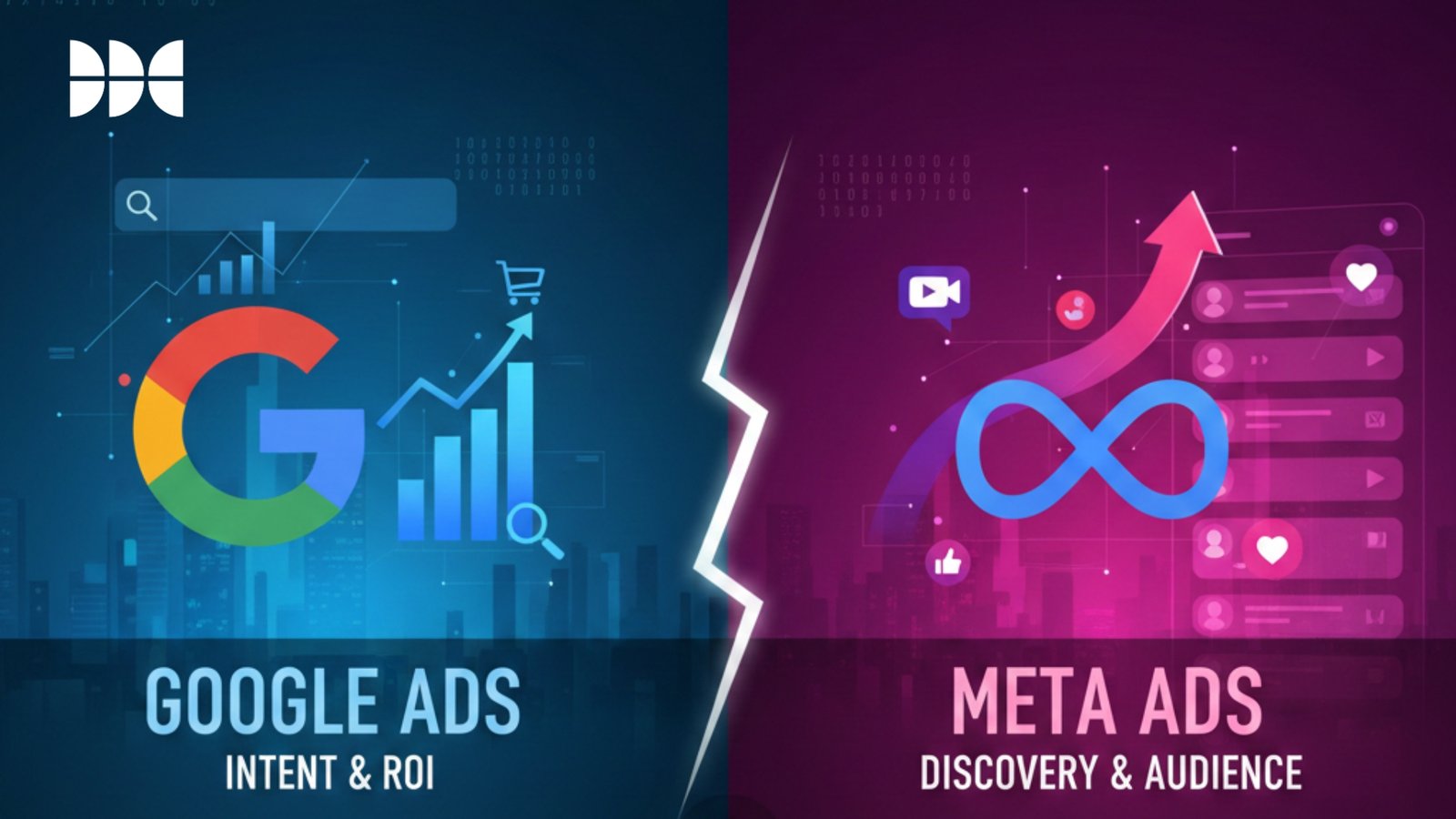
In 2026, successful ad allocation shifts from “Platform Wars” to “Omnichannel Hybrids.” Google Ads remains the king of high-intent “Demand Catching,” while Meta Ads dominates “Demand Creation” through AI-driven Reels. For most SMEs, a 60/40 budget split is recommended based on the business model (B2B vs. D2C). Key success factors in 2026 include using Conversions API for Zero-Party data and leveraging Google’s Performance Max for bottom-funnel conversion.
1. The 2026 Landscape: Beyond the “Either/Or” Myth
The digital advertising world in 2026 looks vastly different than it did even two years ago. With digital ad spend in India projected to hit ₹1,476 billion this year, the competition is fierce. We’ve entered the era of “Black Box” marketing—where AI-driven automation (like Google’s PMax and Meta’s Advantage+) handles the heavy lifting, but the human strategist must handle the budget steering.
Common pain points today? Rising CPCs (Cost-Per-Clicks) and the total disappearance of third-party cookies. If you are still treating Google and Meta as separate silos, you are leaking money. The winners in 2026 use an “Omnichannel Hybrid” approach: using Meta to plant the seed and Google to harvest the crop.
2. The Core Difference: Catching vs. Creating Demand
Before you drop a single Rupee into an ad account, you must understand the psychological state of your user on each platform.
| Feature | Google Ads (The Intent Engine) | Meta Ads (The Discovery Engine) |
| Primary Goal | Catching Demand: Users are actively searching for a solution. | Creating Demand: Users are browsing; you must interrupt them with value. |
| User Mindset | “I need a Digital Marketing Agency in Ahmedabad now.” | “Oh, this brand’s story is interesting. I might need this.” |
| Ad Format | Text, Shopping, and Search-based Video. | High-impact Reels, Carousels, and Story Ads. |
| 2026 Edge | PMax & AI Overviews: Best for BOFU (Bottom of Funnel). | Advantage+ & Reels: Best for TOFU (Top of Funnel). |
3. Data-Driven Allocation Rules
How do you decide where the majority of your 2026 budget goes? Use these two foundational rules.
The 60/40 Rule
While every business is unique, data from 2026 Digital Ad Spend Reports suggests a specific split:
B2B & High-Ticket Services: Allocate 60% to Google Ads (Search/LinkedIn) and 40% to Meta (Retargeting/Awareness). In B2B, you need to be there exactly when the CTO is searching for a solution.
D2C, Fashion, & Lifestyle: Allocate 60% to Meta Ads and 40% to Google Ads (Shopping). Visual discovery drives impulse buys, while Google catches those who later search for your brand name.
The “Product Awareness” Test
If your product is a “Category Creator” (something people don’t know exists), Google Search is useless because no one is searching for it. You must spend 80% of your budget on Meta to educate the market.
Pro Tip: For those seeking long-term organic growth alongside ads, check out our results-oriented SEO strategy to lower your blended CAC (Customer Acquisition Cost).
4. 2026 Special Tactics: The Power Players
Meta Reels for TOFU Awareness
In 2026, static images are secondary. Short-form video (Reels) is the primary engine for Meta’s AI. By creating “Performance Creative”—videos that look like organic content but lead with a problem-solving hook—you can lower your CPMs significantly. This is where we build your Social Media Transformation and brand identity.
Google Performance Max (PMax) for BOFU Conversions
PMax has evolved into a powerhouse. By feeding it high-quality Zero-Party Data (your own customer lists and lead feedback via Conversions API), you allow Google’s AI to find high-value users across Search, YouTube, and Gmail who are ready to buy now.
5. The Privacy Frontier: Zero-Party Data
In 2026, “Cookies” are a relic of the past. High-performing campaigns now rely on the Conversions API (CAPI). By sending server-side data directly to Meta and Google, you bypass browser blocks and improve your attribution accuracy.
However, even the best ads will fail if your destination is poor. Ensuring custom web development for high-converting landing pages is essential to ensure that the traffic you pay for actually turns into a lead.
6. Staying Ahead of the Curve
Marketing changes weekly. To stay informed on the latest algorithm shifts:
Follow Industry Leaders: Check out Social Media Examiner for the latest platform updates.
Get Weekly Audits: Connect with Digi Dream Catcher on LinkedIn where our leadership shares weekly breakdowns of ad-spend audits and winning creative trends.
Stop Guessing. Start Catching.
Are you tired of “Testing” budgets without seeing a clear ROI? In the complex landscape of 2026, a single misconfiguration in your PMax settings or a weak Reel hook can cost you lakhs in wasted spend.
Stop guessing with your ad spend. Get a Free 20-Point Ad Account Audit from Digi Dream Catcher. We will dive into your data, find exactly where you’re leaking money, and show you how to turn your digital dreams into a lead-catching reality.